
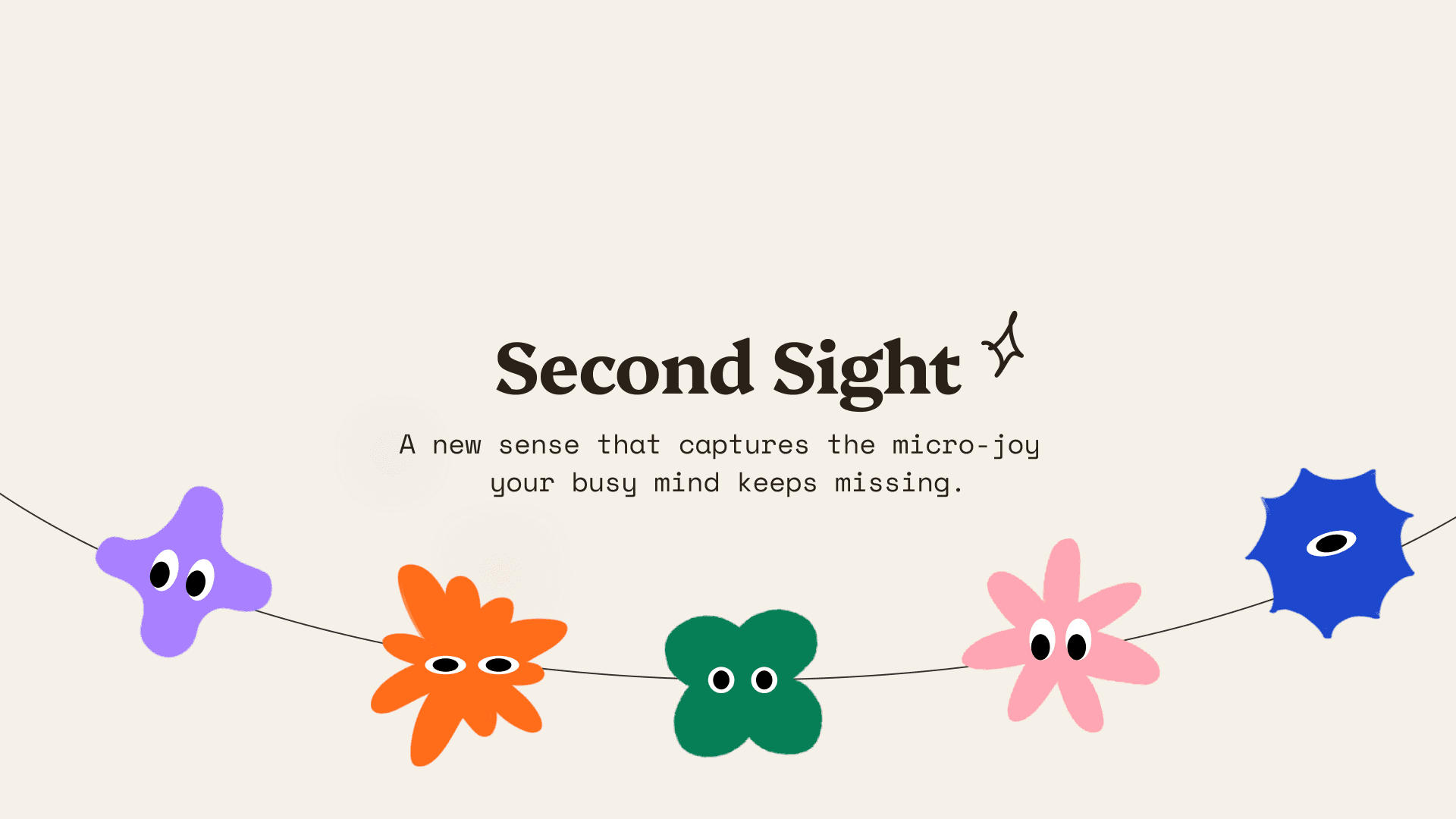
Second Sight
AI-native Experience · FigBuild 2026 Competition Project
Timeline
48 Hours / FigBuild 2026
Tools
Figma, Figma Make, Adobe Effects, Lovable, Claude
My Role
Concept Development, Interaction Design,
Visual Storytelling, Visual System
Prototype Design
Team
Xiaolin Jin (Adalyn Jin)
Rebecca Zhang
Designing a new sense for FigBuild 2026
Second Sight was created during FigBuild 2026, a 48-hour design sprint under the theme of Future Sensing. Our team explored a speculative question: what if emotional wellness did not begin with tracking, fixing, or self-optimization, but with noticing?
Instead of designing another mood tracker or journaling app, we imagined a quiet wearable sense that helps people perceive the small emotional signals their conscious mind often misses.
Second Sight is not a happiness tracker.
It is a sensory companion that helps people recognize the moments their body felt, but their mind missed.
Design Challenge
In a world that tracks everything, what do we still fail to notice?

From Sensing to Reflection
Second Sight was developed around a two-part experience: a wearable ring that quietly detects micro-joy, and an iPad interface that helps users review, understand, and revisit those moments later.

1.Passive Sensing
How micro-joy is detected without manual logging
The wearable ring acts as a quiet sensory layer. Instead of asking users to manually record their feelings, it detects subtle combinations of environmental, social, and body signals, then gently pulses when a micro-joy moment may be happening.

2. Guided Reflection
Turning sensed moments into personal understanding
After the moment passes, the review interface helps users revisit what was captured. Rather than reducing emotions into scores or summaries, it presents micro-joy moments as gentle memory fragments that users can review, edit, and understand in their own words.
3. Emotional Visualization
Making invisible signals feel tangible
Each captured moment becomes a micro-joy spirit. Different colors and forms represent different emotional atmospheres, such as stillness, warmth, connection, or surprise. These spirits make subtle emotional signals feel visible, playful, and revisitable.
4. AI-native Visual Exploration
AI as a tool for visual research and rapid divergence
During the 48-hour sprint, we used AI-generated images as visual references to explore different interface moods, sensing metaphors, and possible futures. These variations helped us narrow the final direction toward a softer, more emotional, and more approachable visual language.

